

Plate bearing apparatus are used to determine the bearing capacity and deformability of soil in situ, which is crucial for designing foundations and pavements. They work by applying a load to a steel plate placed on the ground and measuring the resulting settlement or displacement. This information helps engineers understand how much weight the soil can safely support.
-
Determining Soil Bearing Capacity:
Plate bearing tests provide a direct measure of the soil’s ability to support a load, which is essential for foundation design.
-
Evaluating Soil Deformability:
The test reveals how much the soil will compress or settle under a given load, helping engineers choose appropriate foundation types.
-
Design of Pavements and Road Structures:
The results are used to determine the appropriate thickness and type of pavement layers to ensure stability under traffic loads.
-
Assessing Ground Suitability for Structures:
Plate bearing tests can help determine if the ground is suitable for supporting structures like crane outriggers or piling rigs, especially when heavy equipment is involved.
-
Evaluating Fill Compaction:
The test can assess the degree of compaction in fills, which is important for ensuring stability and preventing future settlement.
-
1. In-situ Testing:
The test is conducted directly on the ground surface or at a shallow depth.
-
2. Applying Load:
A circular steel plate is placed on the ground, and a hydraulic jack applies an increasing load to the plate.
-
3. Measuring Settlement:
Dial gauges or other measuring devices record the settlement or displacement of the plate as the load increases.
-
4. Analyzing Results:
The load-settlement curve is analyzed to determine the ultimate bearing capacity and other deformation characteristics of the soil.
-
Relatively Quick and Easy:
Plate bearing tests are relatively quick to perform and do not require extensive preparation.
-
In-situ Testing:
The tests are conducted on-site, providing a direct measurement of the soil’s in-situ behavior.
-
Useful for Various Applications:The tests are used in a wide range of applications, including foundation design, pavement design, and site investigations.
This test method is used to estimate the bearing capacity of a soil under field loading conditions for a specific loading plate and depth of embedment (ASTM D1194). It is also used for load tests of soil and flexible pavement components for use in evaluation and design of airport and highway pavements.
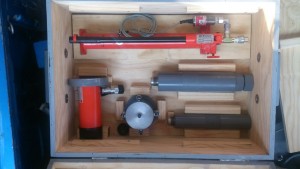
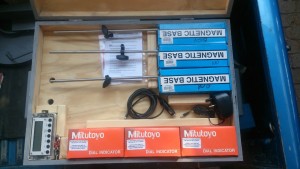
*Picture depicts 25kN Plate Bearing
Plate Loading Test 25kN Set consists of:
- 25kN capacity piston assembly
- hydraulic hand pump,
- pressure transducer,
- M5i battery operated digital readout unit,
- 2.4 m long datum bar,
- 3 x. 25mm x 0.01mm gauges with dial supports
- 3 x Magnetic bases
- 300 mm, 450 mm and 600mm diameter plates.
Plate Loading Test 500kN Set consists of:
- 500kN capacity piston assembly
- Digital readout with peakhold
- Spacer plates
- 3 x Magnetic Bases
- 3 x. 25mm x 0.01mm gauges with dial supports
- 300mm, 450mm, 600mm, 760mm diameter Plates