Liquid and plastic limit apparatus are used to determine the Atterberg limits of soil, which are crucial for understanding soil behavior and classifying soils. Specifically, these apparatus help define the moisture content at which soil transitions between plastic and liquid states (liquid limit) and plastic and semi-solid states (plastic limit).
Key Uses:
-
Soil Classification:The Atterberg limits, particularly the plasticity index (difference between liquid and plastic limits), are used to classify soils based on their plasticity.
-
Engineering Behavior Prediction:These limits help correlate soil properties with engineering behavior like compressibility, hydraulic conductivity, and shear strength.
-
Evaluating Weathering Characteristics:In some cases, they can be used to assess the weathering susceptibility of clay-shale materials.
-
Assessing Liquefaction Potential:The plasticity index, in particular, can indicate a soil’s potential to resist liquefaction.
How it Works:
-
Liquid Limit:The liquid limit test involves placing a soil sample in a cup and rotating it. The number of blows required to close a groove in the sample at different moisture contents is recorded. The liquid limit is the moisture content at which the groove closes after 25 blows.
-
Plastic Limit:The plastic limit test involves rolling a soil sample into a thread until it crumbles. The moisture content at which the soil can still be rolled into a 3 mm (1/8 inch) diameter thread without breaking is the plastic limit.
-
Apparatus:The apparatus includes a grooving tool, a cup, a mechanism for rotating the cup, and a counter to record the number of blows. For the plastic limit test, a glass plate, palette knives, and a brass rod are also needed.
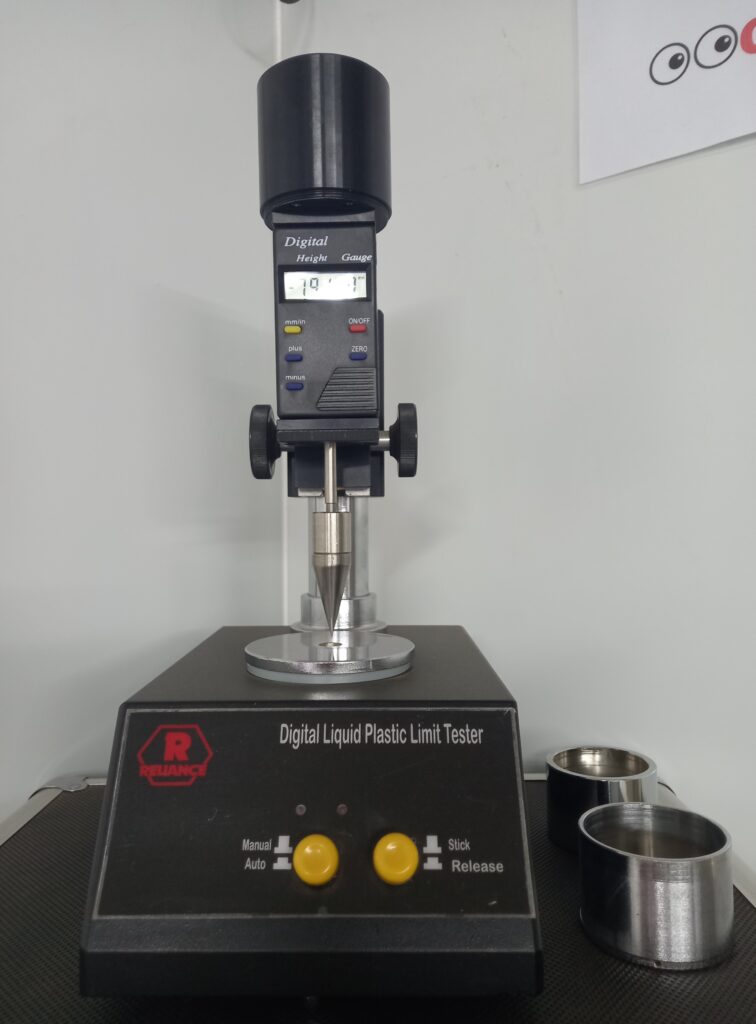
In order to determine the passage from the first to the second state, standards recommend that a test with the cone penetrometer be carried out. Allow to drop and from a fixed height within a definite time on the soil sample. The water content percentage which gives a 20mm penetration is assumed to be the “Liquid Limit”
The digital electronic release model has a 0.1mm graduation and automatic zeroing. The base has leveling screws and provision is made for adjusting cone height in relation to the sample.