
The Average Least Dimension (ALD) is used to determine the quantity of bituminous product needed for road surface treatments and to calculate the spread rate of surfacing aggregates.It’s essentially the average thickness of a representative sample of aggregate particles.
Here’s a more detailed explanation:
- The ALD is the average of the smallest dimension (thickness) of a group of aggregate particles.
- It’s measured by either physically measuring the least dimension of many particles or by calculating it based on sieve analysis and flakiness index.
- A representative sample is crucial; poor sampling or inaccurate testing can lead to errors in design spread rates and binder application rates.
-
Determining Bituminous Product:
The ALD is a key factor in calculating the amount of bituminous product (like asphalt) needed for surface treatments.
-
Aggregate Spread Rate:
It helps determine how much aggregate should be spread per unit area of the road surface.
-
Design Application Rate:
The ALD influences the design of the amount of binder to be applied.
-
Aggregate Layer Thickness:
For aggregate sizes 10mm and larger, designs assume a single layer of aggregate adheres to the binder. However, for smaller aggregates, the layer can be multiple particles thick, and the ALD helps account for this.
- Physical Measurement: Individual particles are measured using tools like Vernier calipers.
- Computational Method: The ALD can also be calculated using sieve analysis and the flakiness index, according to a method outlined by CSIR Pretoria [3, 1].
The accuracy of the measured ALD method TMH1-B18(a) (Technical Methods for Highways) depends on the sampling process, the sample size, measuring equipment, the interpretation of the least dimension, and the fraction of the sample not measured. The computational method TMH1-B18T(b), currently in use, is inaccurate and also does not take full account of the nature of the particle size distribution, which has an effect on the estimated measured ALD.
Options:
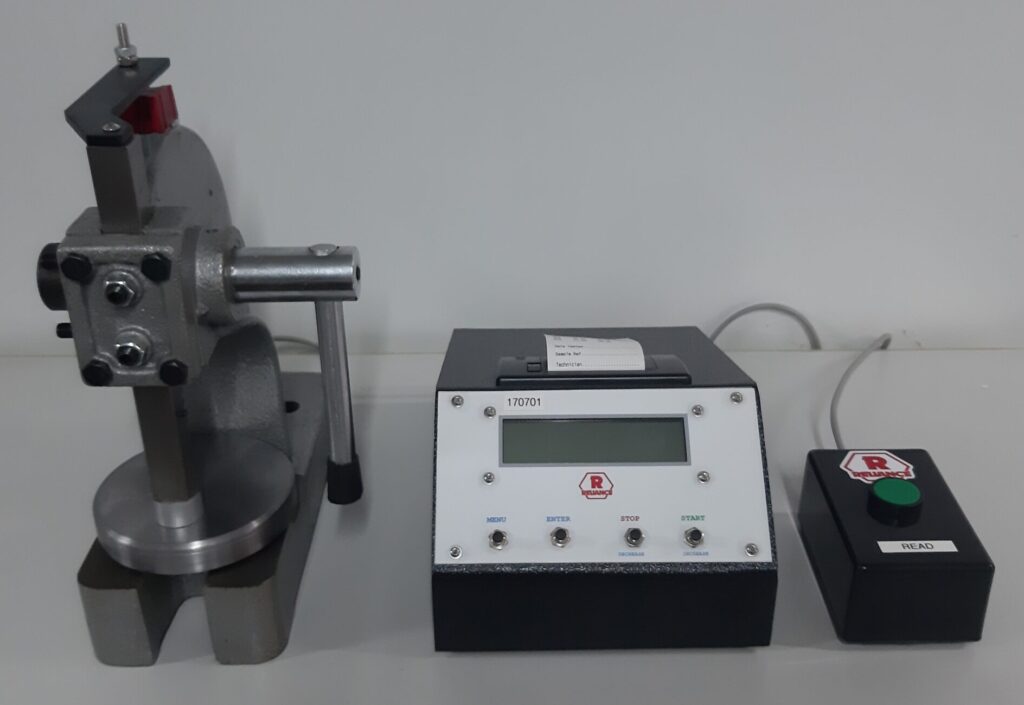
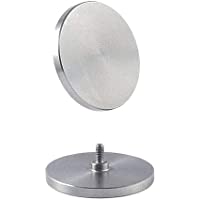
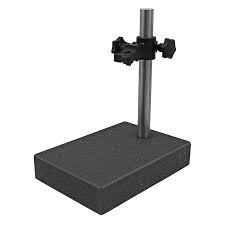
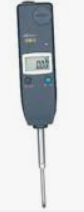
- Manual – Dial gauge, Foot piece & Stand
- Standard – Complete ALD including Printer
- Plus – Complete ALD, printer & Software
Laptop is not included
Software
Specifications:
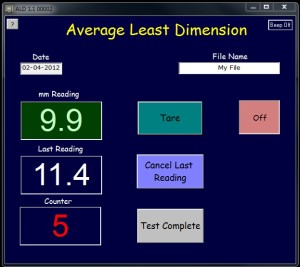
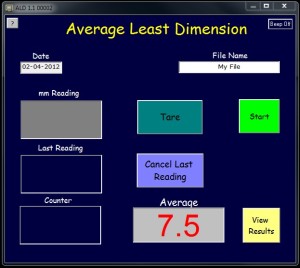
| mm Reading | Displays the Actual millimetres. |
| Last Reading | Displays the last value |
| Counter | Counts the number of reading taken |
| Tare | Zeros the mm Display |
| Cancel Last Reading | Removes the last value form the test average..Resets the Counter |
| Test Complete | Stop’s the test before 200 readings, should one choose to do so |
| File Name | Enter your Reference No/Name…On completion of the test, the results are save in a text format on the C Drive “C:Ald_Test_Results.” |
| Start | Starts a test, all previous data is erased…Requires a File Name |
| Beep off |
Stops the Beeping sound after a reading has been taken
|

MANUAL:
Click below for User Manual: