
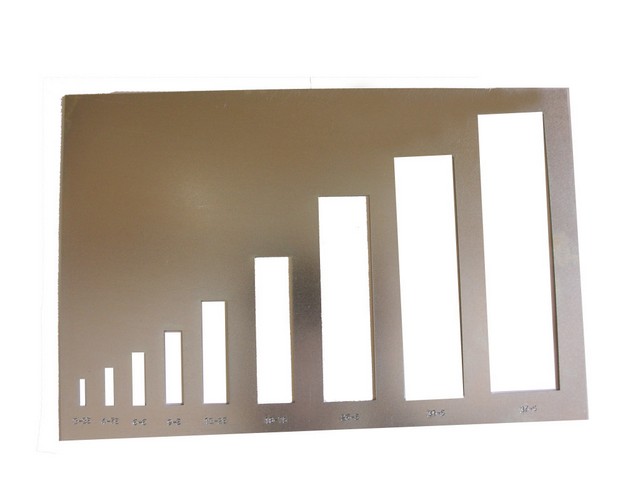
Flakiness gauges are used to determine the flakiness index of aggregates, which classifies particles based on their thickness relative to their nominal size. Specifically, they identify particles where the least dimension is less than 60% of the average size of the sieve fraction. This helps ensure that aggregates meet specified shape requirements, impacting concrete workability, strength, and overall project quality.
More details:
-
Purpose:The primary function of a flakiness gauge is to classify aggregate particles based on their shape, specifically determining if they are “flaky”.
-
Definition of Flaky:A particle is considered flaky when its smallest dimension (thickness) is less than 60% of the average size of the sieve fraction it belongs to.
-
How it Works:The gauge typically uses a series of slots of varying widths. Particles are manually tried against these slots, and those that don’t pass are identified as flaky.
-
Importance:Flakiness index tests are crucial in construction, particularly for asphalt and concrete, to ensure that aggregates meet the required shape specifications.
-
Impact:Excessive flakiness in aggregates can negatively impact concrete workability, strength, and durability. A low flakiness index generally indicates better material properties.
Flakiness gauge according to TMH 1 Method B3 (BS 812)
| Minimum Length of Slot | Width of Slot |
| 150,0 mm | 37,5 mm |
| 126,0 mm | 31,5 mm |
| 106,0 mm | 26,5 mm |
| 75,0 mm | 18,75 mm |
| 53,0 mm | 13,25 mm |
| 38,0 mm | 9,5 mm |
| 26,4 mm | 6,7 mm |
| 19,0 mm | 4,75 mm |
| 13,4 mm | 3,35 mm |
Flakiness gauge according to SANS 3001-AG4: 2009
| Minimum Length of Slot | Width of Slot |
| 150,0 mm | 37,5 mm |
| 100,0 mm | 25,0 mm |
| 75,0 mm | 18,7 mm |
| 50,0 mm | 12,5 mm |
| 40,0 mm | 10,0 mm |
| 27,0 mm | 7,0 mm |
| 20,0 mm | 5,0 mm |
| 15,0 mm | 3,5 mm |