
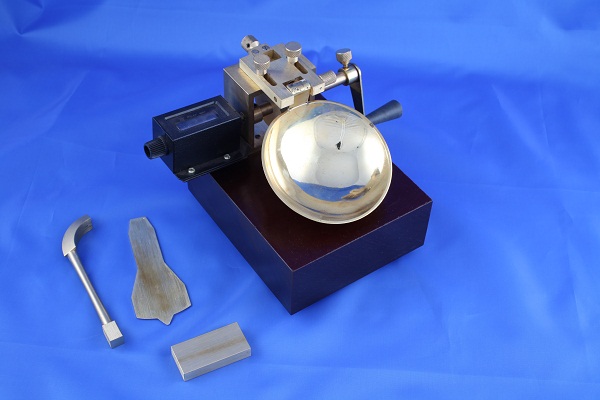
Liquid limit devices, such as the Casagrande apparatus, are used to determine the moisture content at which fine-grained soils (like clay and silt) transition from a plastic state to a liquid state.This information is crucial for classifying soils and understanding their behavior, which is important for designing and constructing foundations, slopes, and other earthworks.
-
What it does:
The device measures the moisture content at which a groove in a soil sample closes when subjected to standardized blows, according to the Casagrande method.
-
Why it’s used:
The liquid limit is one of the Atterberg limits, which help characterize the consistency and behavior of soils with varying moisture contents, according to ScienceDirect.com.
-
How it’s used:
A soil sample is mixed with water to form a paste, which is then placed in a cup on the device. The cup is rotated at a controlled rate, causing the grooving tool to create a groove in the sample. The number of blows needed for the groove to close indicates the liquid limit.
-
Benefits:
Understanding a soil’s liquid limit helps engineers:
- Classify soils based on their plasticity.
- Predict their behavior under different moisture conditions.
- Design foundations, slopes, and other earthworks that can withstand the soil’s potential for liquefaction during earthquakes.
- Classify soils based on their plasticity.
-
Types of Devices:Liquid limit devices can be hand-cranked or motorized, and they may or may not have an automatic counter.
Liquid Limit Device (LLD)
With base that conforms to SANS specifications and removable brass bowl. The height of drop of the bowl may be adjusted via the hand crank mechanism. A built-in blow counter is supplied as standard. Grooving tool/s & calibration block are not supplied with and must be ordered separately
Accessories and spare parts:
- Grooving tool (ASTM)
- Grooving tool (AASHTO – UNI)
- Calibration block
- Spare bowl
- LLD Base